For health practices
Found on Google. More new patients. Paperwork done.
AI changed how people find a practice. We come to you, pick the few fixes that make the biggest difference, and set them up in your own accounts.
- Found on the mapPractice, Springwood New
- Enquiry answeredKept in one list Replied
- Monthly emailConsent on file Ready
- Referral letterDrafted from notes Check
For health practices
The things keeping you up at night.
New patients go elsewhere, the front desk is stretched, and the letters wait for the evening.
- Nobody finds us when they search.
- Another practice gets named first.
- Gaps open in the book every week.
- The enquiry sits in an inbox nobody opens.
- The letters wait for Sunday night.
- Nobody knows if the AI scribe is allowed.
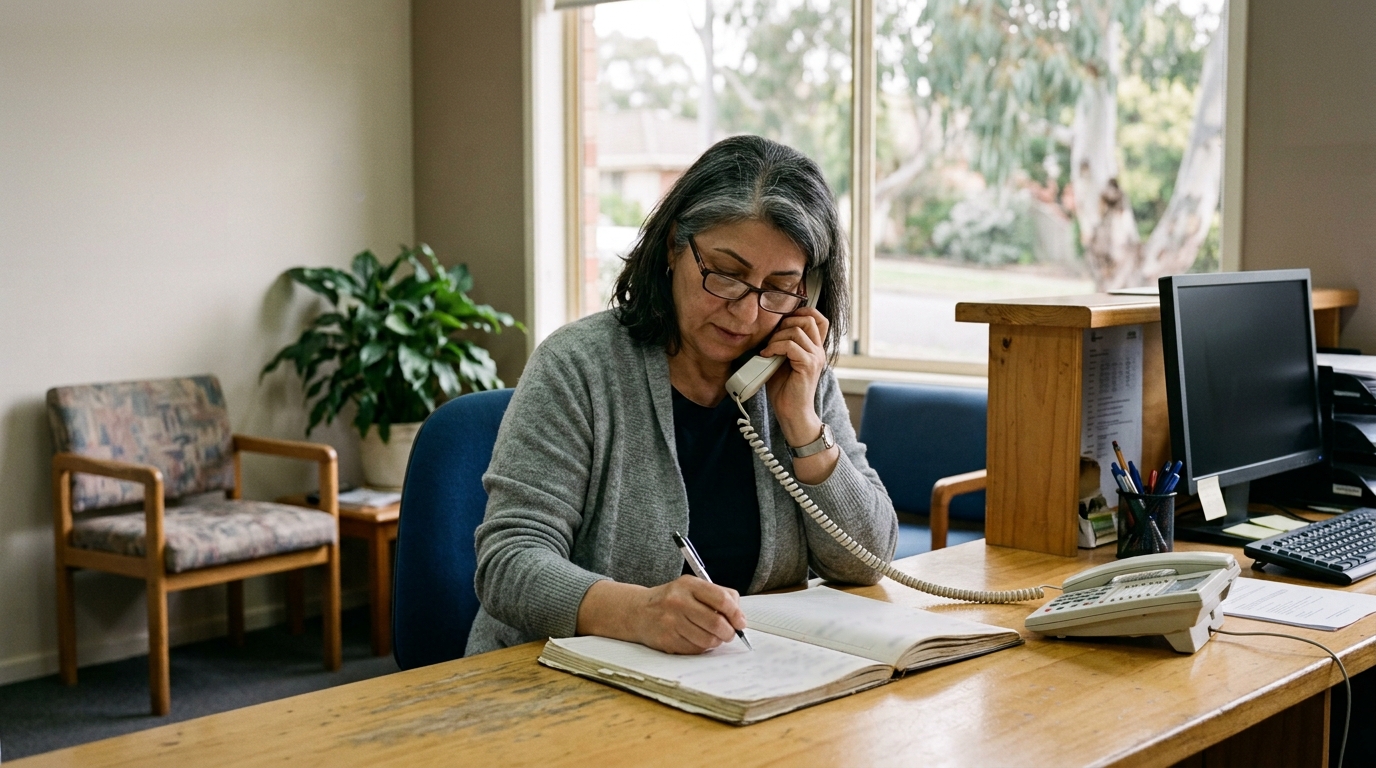 Phone, book and letters at once
 What changed
People stopped searching. They ask an AI.
The same machine now answers and drafts for a practice that used to need a bigger desk. Get AI Working exists to get that machine working for practices like yours.
-
Then: you had to be in the list
Somebody searched, scrolled a page of links, and rang whoever looked closest. Everybody listed was in the running.
-
Now: one practice gets named
Google writes the answer itself and the AI assistants name a practice or two. Most people never scroll.
-
What to do: be the name in the answer
Build the listing, the pages and the reviews a machine can check, inside the rule barring a testimonial.
Sources + notes
Asked to recommend a local business in two Blue Mountains towns, an AI assistant named none at all.1 Nobody can pay for a better local ranking, and Google says so itself.4
A patient’s words about a treatment or a result cannot go in an advert, at up to AU$60,000 an offence.2 AHPRA draws the line at clinical content rather than at the word review, and encouraging reviews is not prohibited.3
The small business exemption never covers a practice that provides a health service and holds health information. A patient’s contact details are health information, so outreach goes only to the list you hold consent for.5
AHPRA says generative AI scribes are not regulated by the TGA, and the TGA says a scribe that suggests a diagnosis you did not state is a medical device.6 Best Practice already sends reminders and recalls, so whatever yours does comes off the scope.9
The wider health district counted 132 general practices as at September 2025, a quarter of its GPs already over 65.7 We are based in Blaxland and work up to Katoomba, 38.6km by road.8
- Measured by us. Two questions put to an AI assistant on 25 August 2026 for a Blue Mountains business: asked for the best agents in the Lower Blue Mountains it named two franchise brands and no local firm; asked who to use to sell a house in Glenbrook or Blaxland it named no local business at all. One catchment, one day, two questions: a shape, not a benchmark, and the reason we re-run the questions monthly for every client.
- Verified. Health Practitioner Regulation National Law (NSW) s 133, version current for 10 April 2026, legislation.nsw.gov.au, read 4 September 2026. s 133(1)(c) prohibits advertising that “uses testimonials or purported testimonials about the service or business”, at up to AU$60,000 an offence for an individual and up to AU$120,000 for a body corporate. Medicine, dentistry, physiotherapy, psychology, pharmacy, nursing and midwifery are among the professions bound.
- Verified. AHPRA, Guidelines for advertising a regulated health service, issued 14 December 2020, page reviewed 2 September 2025, and the AHPRA testimonial tool, page reviewed 23 August 2021, both read 4 September 2026. Verbatim: “comments about customer service or communication style that do not include a reference to clinical aspects are not considered testimonials for the purposes of the National Law.” The prohibition on encouraging reviews was in the draft, was objected to in consultation and is absent from the final document.
- Verified. Google’s AI features documentation, 10 December 2025: “There are no additional requirements to appear in AI Overviews or AI Mode, nor other special optimizations necessary.” Google, Tips to improve your local ranking on Google, support.google.com, read 29 August 2026, for “There’s no way to request or pay for a better local ranking on Google.” Our Get Found page carries the study behind what gets a page quoted in full.
- Verified. Privacy Act 1988 (Cth) s 6D(4)(b), read on the Federal Register of Legislation 4 September 2026: an operator is not a small business operator if it provides a health service and holds health information. OAIC APP Guidelines Chapter 7, read the same day, for APP 7.4 and for “The requirement to obtain consent applies even if the individual and the organisation have a pre-existing relationship.”
- Verified. AHPRA, guidance on the use of AI in healthcare, page reviewed 22 August 2024, read 4 September 2026: generative AI scribes “are not regulated by the TGA”, and their use “will generally require informed consent from your patient/client”. TGA, guidance on digital scribes and clinical documentation software, last updated 30 January 2026, read the same day: a scribe that generates a diagnosis or treatment recommendation the practitioner did not state is a medical device, and products not on the ARTG are being “supplied illegally”.
- Published, with flags. Nepean Blue Mountains Primary Health Network, Needs Assessment 2025, posted April 2026, read 4 September 2026: 132 general practices in the region as at September 2025, 502 full-time-equivalent GPs behind them, and 26% of those GPs already over 65. Flag: that region is the health district’s rather than this catchment, taking in Lithgow and leaving out nine of the thirteen councils this site works across.
- Reported, not verified. The Blaxland to Katoomba road distance of 38.62km is published by distance-cities.com, accessed 20 August 2026.
- Verified. Best Practice (bestpracticesoftware.com/), read 22 September 2026: “Send appointment reminders, recalls and clinical updates directly from your practice software.” bestpracticesoftware.com/bp-premier/, read the same day, carries a customer quote about sending “an individual SMS to a patient for a recall.” Cliniko (cliniko.com/features/ and help.cliniko.com/en/articles/2890282), read the same day: automated SMS or email appointment reminders and confirmations for a booked visit, with no recall claim on its own page.
What we set up
What it looks like on a real day.
Drawn examples of what we set up, not client results.
Who’s a good practice in Springwood that’s taking new patients?
From listings and recent reviews nearby, the closest match is:
- Covers Springwood, taking new patients
- Services and fees listed
- Recent reviews, every one answered
Two others also match. Want their details?
- This month’s emailTo patients who said yes Approve
- A month of postsApproved in one sitting Ready
- Adverts in their feedAcross your suburbs, capped Live
- New patient enquiryAnswered, in one list Booked
- Referral letterDrafted from your notes Check
- After-hours enquiryAnswered and logged Logged
- Security and access policyDrafted, dated and filed Filed
- Receipts and billsCoded into your books Filed
What it costs
What it costs, and how you pay.
Three bundles, each priced from a figure that moves with your practice, or any service on its own.
- Get Found
Easy to find, check and contact, wherever customers look.
Seven services, measured at 90 days on where you show and what the AI assistants say about you.
- Show up on the map
- Ask the AI about you
- More reviews
from AU$1,790
What is in it - Sell More
More enquiries turn into paying customers.
Eight services: a website that sells, every enquiry answered and in one place, the social posts, and the adverts.
- A website that sells
- Every enquiry in one place
- Social posts done for you
from AU$2,490
What is in it - Get Time Back
The paperwork off your evening.
Eight services, measured on the hours a week you get back.
- Stop typing it twice
- One screen that shows how the business is going
- Your spreadsheets turned into one proper system
from AU$2,490
What is in it
The AU$499 starter does the two things every practice needs first: your Google profile done properly, and every patient asked for a review inside the rules. Spread the payments over 3, 6 or 12 months, interest-free, depending on the size of the work.
A bundle is scoped before it is priced. If Best Practice or Cliniko already sends your reminders and recalls, we are not paid to do it again.
On a quiet website the Sell More bundle carries adverts in their feed instead of adverts to past visitors, because Google needs enough visitors before it will show those. Why
How it works
The Switch‑On Method.
Five steps, the same every time. Switched on inside 30 days.
-
Listen
A free first hour about your business, not about AI. You leave with your insight portal: a private page about your business, your trade and your area.
-
Scope
One page in plain English: what we do, what it costs, what we measure.
-
Build
Set up inside the accounts you already own. Nothing to migrate into.
-
Train
Your people shown how to drive it, on your real work, until it sticks.
-
Measure
At 90 days we measure against day one and show you the before and after.
Why us
Six reasons owners pick us.
A local practice that builds in your accounts, hands everything over, and tells you straight.

We set you up, and it’s yours
We set it up in your accounts, hand over every login, and teach you to change it. You don’t pay us forever.
We pick what fits
No packages. We pick the few things that will make the biggest difference, tell you what’s not worth it, and what you can stop paying for.
It costs less to start
Start from AU$499, with the price in writing before we start. Three months’ support included, then optional at AU$99 a month.
We’re where you are
We’re local. We sit down with you in your business, and you can always reach a real person.
It moves fast
Most things are set up in days or a few weeks.
Someone to ask about AI
Not sure who to ask about AI? Ask us: we’ll tell you straight, and we can set it up.
Included with every paid engagement
One hour with us, in person, on the AI you actually want to ask about.
A free workshop on Claude Code or Codex, for you and whoever you bring. Everything we build afterwards sits on it.
Ask what you actually want to ask
Whether it will replace you, what it gets wrong, what it costs to run. No question is too basic.
Say what worries you
Customer data, staff, the law, sounding like a robot. We go through each one with your business in front of us.
Set the goals for the engagement
The hour a week you want back, the enquiry you keep missing. Written down, then measured.
Learn to drive it yourself
By the end you can ask the machine to change your website, redraft an email or rerun a report.

Questions
What practice owners ask before they book.
If yours is not here, ask it in your free hour.
Whether a health practice may ask a patient for a review
Yes: the prohibition on encouraging reviews was in the draft and is absent from the final guidelines.3 What you may not do is publish a patient’s words about a treatment or a result, at up to AU$60,000 an offence.2
Whether the small business exemption covers your practice
It does not: an operator is not a small business operator if it provides a health service and holds health information, whatever your turnover.5
Whether you can email your patient list about a new service
Only with consent: a patient’s contact details are health information, which is sensitive information.5 Recall and clinical follow-up generally sit outside that rule, which is why we start with the consent you hold.
Whether an AI scribe is a medical device
That depends which of your two regulators you ask, and they disagree in writing.6 We will write down which position your product sits on, and date it.
What it costs, and what you get for it
Any service on the menu is bought on its own, or together as a bundle from AU$1,790 or AU$2,490. The figure is in writing before you commit a dollar, and it is built in accounts you own.
Who owns the accounts, and what happens after
You do: everything is built in accounts under your own passwords, and whatever we build is yours. Three months’ support is included, then it’s optional at AU$99 a month.
Start here, free
Find out who Google names for your practice today.
An hour, at the practice or on the phone, and free: we show you what Google and the AI assistants say about your practice and who they name instead. This page and that conversation are general information, not legal advice.
Or write to hello@getaiworking.com.au, answered by the person who would do the work. What happens after
- Fix the Google profile first
- Check what the AI assistants say
- Pick the one job to hand over
- Your business, checked
- Your trade, compared
- Your area, mapped